The Japanese POW Colonel’s Assassination
The Wind-Up Bird ChronicleThe Japanese POW Colonel’s Assassination is the turning point at which Boris Gromov’s carefully cultivated appearance of restraint gives way to overt control of the Japanese prisoners. Boris ordered the killing of the colonel, the central figure on their prisoner committee, and arranged for Japanese subordinates to carry it out. The death was attributed to illness, while the committee’s subsequent choice of Boris’s preferred replacement made the prisoners’ nominal self-government an instrument of the system ruling them.
Background: autonomy under Boris
The murder followed a brief period in which the prisoners had been allowed to manage some of their own affairs. After gaining control of the Russian guards, Boris left the Japanese committee in place and permitted it to obtain a limited easing of the labor regime. The calm was genuine in its immediate effects, but it concealed a methodical effort to bring committee members individually under his influence through bribes and threats. Under the appearance of granting autonomy, Boris was building a more efficient structure of control.
The colonel stood in the way of that consolidation. He confronted Boris directly on several matters concerning the prisoners, and by the time Boris turned to him, the colonel and a few associates were among the committee members who had not come under Boris’s influence. After six months of strengthening his position, Boris began applying pressure. The colonel became its first victim.
The killing and its concealment
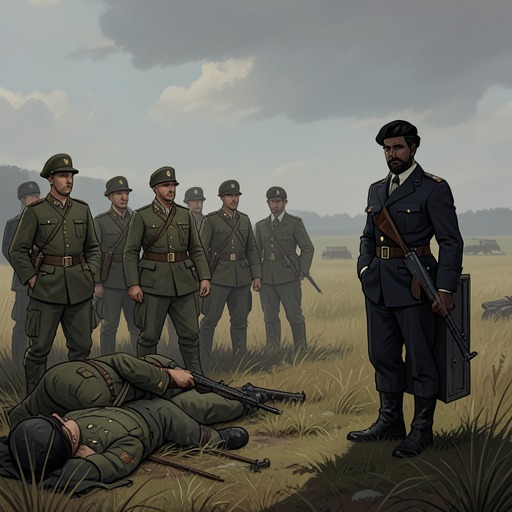
Boris ordered the colonel’s death but did not carry it out himself. Japanese committee members acting under his direction killed the colonel, and the death was officially written off as illness. The prisoners understood what had happened, but Boris had spies among them, so they could not safely discuss the killing. The gap between the public explanation and what everyone knew turned silence into part of the camp’s system of control.
Afterward, the committee voted for Boris’s handpicked candidate to occupy the colonel’s chair. This replacement did more than fill a vacancy: it changed the balance of the committee and made it easier for Boris to govern through its members rather than through direct intervention alone. The assassination thus connected private coercion to an outwardly procedural transfer of authority.
Consequences in the camp
As the committee’s composition changed, the labor conditions worsened. Production quotas were raised in stages, and the Japanese prisoners were made to oversee their own work in place of the Russian officials who had previously supervised it. The promised autonomy increasingly meant responsibility for enforcing a harsher regime without the power to resist it. Accidents rose, and prisoners died under increasingly dangerous mining conditions.
The prisoners’ shared hardship also gave way to distrust and resentment. Those who served Boris received lighter duties and privileges; those who did not faced severe conditions and the danger of being killed. Open complaint was unsafe. In this way, the colonel’s removal helped replace the committee’s limited collective representation with a divided community in which survival and privilege depended on accommodation to Boris.
Mamiya’s responsibility and the event’s significance
Lieutenant Mamiya felt responsible for having brought Boris and the colonel together. He acknowledged that Boris might eventually have gained influence by another route, but that possibility did not relieve his sense that he had made a terrible mistake. His response places the assassination within a broader pattern of constrained responsibility: a connection made under camp conditions could become part of a machinery of control, even when its consequences were not intended.
The event also extends the book’s account of political power beyond the battlefield. Earlier, Lieutenant Mamiya had served in the Kwantung Army and witnessed the violence and coercion associated with the Japanese presence in Manchuria; his later testimony describes a camp where another regime uses administrative arrangements, labor quotas, secrecy, and selective violence to dominate prisoners. The colonel’s assassination is therefore both a specific murder and the decisive failure of the prisoners’ brief self-government. Boris’s control is advanced not only by the killing itself but by the committee’s continued existence after its independence has been hollowed out.